
Blog
Navigating the Future AI, Automation, and n8n Workflows

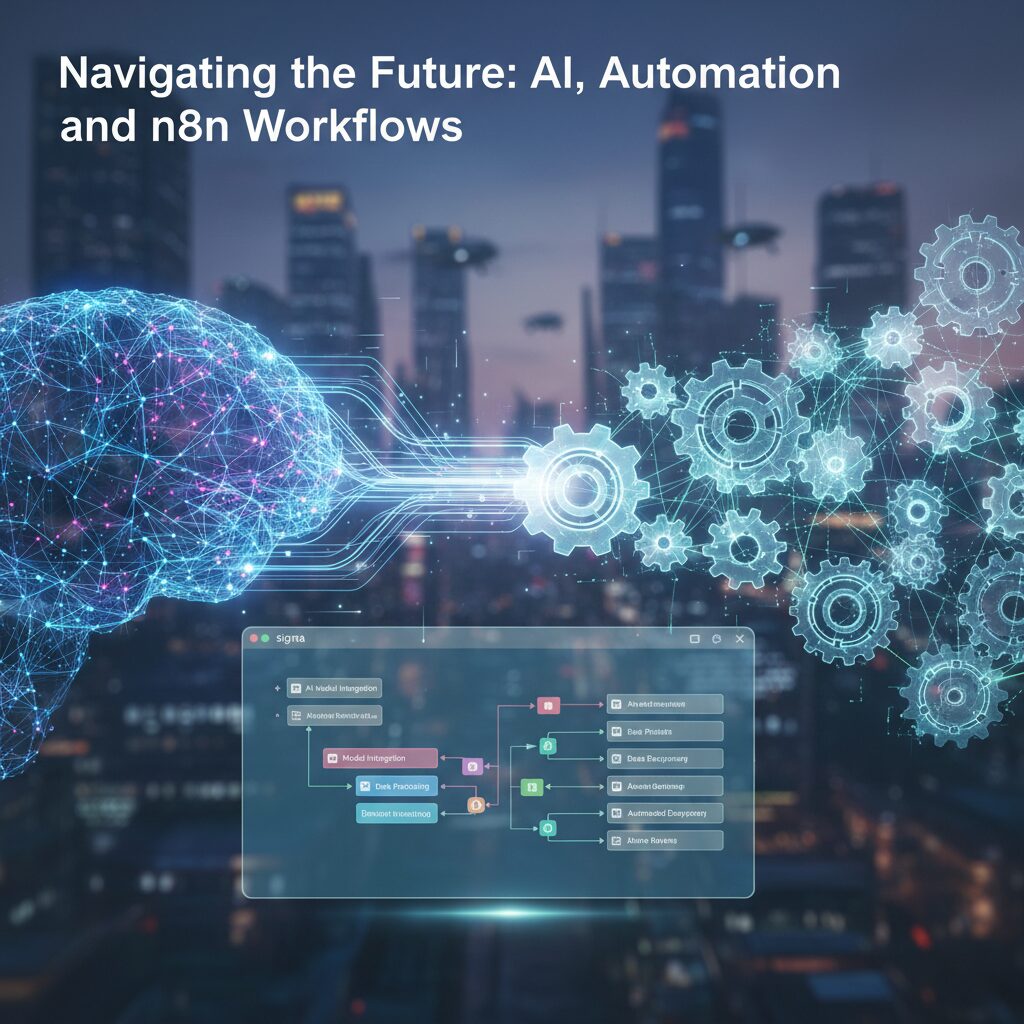
The landscape of business and technology is rapidly evolving, driven by the transformative power of artificial intelligence and advanced automation. As organizations seek greater efficiency and innovation, understanding how AI converges with practical automation tools has become essential for staying competitive.
The AI-Driven Future of Automation
Artificial Intelligence is no longer a futuristic concept — it is actively reshaping how automation works today. Through machine learning, natural language processing (NLP), and computer vision, AI is moving automation beyond simple, repetitive tasks into cognitive processes that previously required human judgment.
Industries ranging from logistics and finance to healthcare and e-commerce are already seeing the impact. AI-powered robotic process automation (RPA) can now read invoices, classify support tickets, analyze contracts, and route customer requests — all without human intervention. Concepts like hyperautomation — the idea of automating as many business and IT processes as possible — are becoming mainstream as tools mature and become more accessible.
The key shift is that AI enables systems to learn from data, adapt to new situations, and make informed decisions rather than just following fixed rules. This transforms operational efficiency and opens entirely new business models.
Current Trends in Workflow Automation
Several major trends are defining the current state of workflow automation:
- Low-code / no-code platforms — Tools that allow non-developers to build automated workflows through visual interfaces are democratizing automation for entire organizations.
- Cloud-based automation — Cloud adoption means workflows can integrate with dozens of SaaS applications seamlessly, without managing complex infrastructure.
- End-to-end process automation — Businesses are moving beyond automating single tasks to automating entire processes from trigger to outcome.
- Citizen developer movement — Marketing, operations, and HR teams are building their own automations without relying on IT departments.
- AI-enhanced decision nodes — Modern workflows incorporate AI models at key decision points, allowing dynamic branching based on intelligent analysis rather than static conditions.
These trends are driven by the need for greater agility, scalability, and efficiency — and they set the stage for even deeper AI integration in the years ahead.
Mastering Automation with n8n
Among the tools available today, n8n stands out as one of the most flexible and powerful workflow automation platforms. It is open-source (fair-code licensed), meaning you can self-host it for full data privacy or use the cloud-managed version for convenience.
What makes n8n practical for real-world use:
- Visual node-based editor — Build workflows by connecting nodes visually. No deep coding knowledge required for most use cases.
- 350+ integrations — Connect Slack, Google Sheets, Airtable, HubSpot, WooCommerce, Notion, and hundreds more out of the box.
- Custom code when needed — For advanced logic, you can write JavaScript or Python directly inside nodes.
- Webhooks and triggers — Workflows can be triggered by form submissions, API calls, scheduled times, or events from connected apps.
Practical examples of n8n workflows businesses are using right now:
- Automatically syncing new WooCommerce orders to a CRM and sending a WhatsApp confirmation
- Pulling data from multiple Google Sheets and generating weekly summary reports
- Routing new contact form submissions to the right team member based on topic keywords
- Monitoring competitor prices and triggering alerts when changes are detected
- Auto-posting scheduled blog content across LinkedIn, Twitter, and Facebook simultaneously
Conclusion
The synergy between artificial intelligence and automation is redefining how businesses operate, moving organizations toward unprecedented levels of efficiency and innovation. Tools like n8n empower teams to implement complex, intelligent workflows without needing a dedicated engineering team. By embracing these technologies thoughtfully, businesses can unlock new competitive advantages and navigate the future of work with confidence.
At Web Creative Clicks, we help businesses integrate automation and AI-powered tools into their digital infrastructure. Contact us to discuss how automation can save your team hours every week.
Frequently Asked Questions
How long does it take to see results in Digital Marketing?
The timeline for digital marketing results varies depending on the strategies employed. For instance, Search Engine Optimization (SEO) typically takes 3 to 6 months to show significant organic growth, as search engines need time to index and rank your content. On the other hand, Pay-Per-Click (PPC) advertising or Social Media Ads can generate immediate traffic and leads within hours of launching a campaign. The best approach usually involves a mix of both short-term and long-term strategies to ensure consistent growth.
Why is having a mobile-friendly website so important?
In today’s digital landscape, the majority of web traffic comes from mobile devices. If your website is not optimized for smaller screens, users will experience a frustrating interface, leading to high bounce rates. Furthermore, Google uses mobile-first indexing, meaning it predominantly uses the mobile version of the content for indexing and ranking. A responsive, mobile-friendly design is no longer just a luxury—it is a critical requirement for both user experience and search engine visibility.
Can AI replace human creativity in content generation?
While Artificial Intelligence (AI) tools have made incredible leaps in generating text, images, and basic code, they cannot fully replace human creativity and strategic thinking. AI is best used as a powerful assistant—it can help brainstorm ideas, draft outlines, and analyze large datasets quickly. However, the unique voice, emotional intelligence, and nuanced understanding of a brand’s specific audience still require a human touch to truly resonate and build authentic connections.
What makes a website convert visitors into customers?
A high-converting website combines several key elements: a clear value proposition, intuitive navigation, fast loading speeds, and compelling Calls-to-Action (CTAs). Trust signals such as client testimonials, case studies, and secure payment icons also play a massive role. The user journey must be frictionless, meaning every step from landing on the homepage to completing a purchase or filling out a contact form should be incredibly simple and straightforward.
🔗 The Real Business Impact of AI + Automation Integration
Beyond efficiency, the combination of AI and automation is fundamentally changing how businesses operate and scale. In 2026, companies are no longer asking “Should we automate?” but rather “How much of our business can be intelligently automated?”
This shift is creating a new category of organizations: automation-first businesses.
These companies benefit from:
- Lower operational costs
- Faster decision-making cycles
- Reduced human error
- Scalable workflows without increasing headcount
📌 The real advantage is not just speed—it is consistency at scale.
🧠 From Task Automation to Decision Automation
Traditional automation was limited to executing predefined tasks. Modern AI-powered systems now extend into decision automation, where systems can choose between multiple outcomes based on data.
Examples include:
- Automatically approving or rejecting invoices based on risk scoring
- Routing leads to different sales teams based on intent signals
- Adjusting marketing budgets based on real-time campaign performance
- Prioritizing customer support tickets using sentiment analysis
This is where AI becomes transformative: it replaces not just manual work, but repetitive decision-making.
⚙️ Why Workflow Design Matters More Than Tools
One of the biggest misconceptions in automation is that success depends on the tool itself.
In reality, success depends on workflow architecture.
Even powerful tools like n8n, Zapier, or Make can fail if workflows are poorly designed.
Strong automation architecture includes:
- Clear triggers (what starts the process)
- Defined decision points (where AI or logic intervenes)
- Error handling (what happens when something fails)
- Scalable structure (ability to grow without breaking)
📌 The tool is secondary—the workflow design is what determines performance.
🔄 AI Agents: The Next Evolution of Automation
The next phase of automation is the rise of AI agents—systems that do not just execute workflows but actively manage them.
Unlike traditional automation, AI agents can:
- Interpret goals instead of fixed instructions
- Break tasks into sub-steps automatically
- Adapt workflows when conditions change
- Learn from past executions
For example:
Instead of a workflow that simply sends emails, an AI agent can:
- Analyze customer behavior
- Decide the best timing and message
- Personalize content dynamically
- Adjust strategy based on response rates
📌 This moves automation from “if-this-then-that” to goal-driven execution.
📊 The Role of Data in Intelligent Automation
AI-powered automation is only as strong as the data behind it.
Businesses in 2026 must ensure:
- Clean and structured data pipelines
- Real-time data syncing between tools
- Centralized data storage (CRM, ERP, analytics systems)
- Proper tracking of user and business events
Without quality data, automation becomes unreliable and inconsistent.
📌 Data is no longer just reporting—it is the fuel for automation intelligence.
🔐 Risks and Challenges of AI Automation
While the benefits are significant, AI-driven automation introduces new risks that businesses must manage carefully:
1. Over-automation
Automating processes that require human judgment can lead to poor customer experiences.
2. Lack of oversight
Fully automated systems can fail silently if not monitored properly.
3. Data privacy concerns
AI systems often process sensitive business and customer data.
4. Dependency on systems
Over-reliance on automation can create operational vulnerability during outages.
📌 Successful companies balance automation with human control points.
🧭 Building an Automation Strategy in 2026
To effectively implement AI and workflow automation, businesses should follow a structured approach:
Step 1: Identify repetitive processes
Focus on tasks that are time-consuming and rule-based.
Step 2: Map workflows clearly
Understand inputs, outputs, and decision points.
Step 3: Introduce automation gradually
Start small before scaling across departments.
Step 4: Integrate AI where decisions exist
Use AI only where interpretation or prediction is needed.
Step 5: Monitor and optimize continuously
Automation is not static—it evolves with business needs.
🚀 The Competitive Advantage of Automation-First Companies
Businesses that adopt AI-powered automation early are gaining a structural advantage in the market.
They are able to:
- Respond faster to customer needs
- Launch products and campaigns quicker
- Operate with smaller, more efficient teams
- Scale globally without proportional cost increases
📌 In 2026, automation is no longer an efficiency upgrade—it is a competitive requirement.
🏁 Final Insight: The Future Is Hybrid Intelligence
The future of business is not fully automated or fully human—it is hybrid intelligence.
- Humans define strategy, creativity, and direction
- AI handles execution, optimization, and scaling
- Automation connects systems into unified workflows
Together, they create organizations that are faster, smarter, and more adaptive than ever before.
💬 Final Thought
AI and automation are not replacing business teams—they are reshaping how teams work.
Companies that embrace this shift will not just improve efficiency—they will fundamentally redefine how value is created in the digital economy.