
Blog
UX Designers’ Struggle with AI Prototyping: Embrace Engineer Partnership

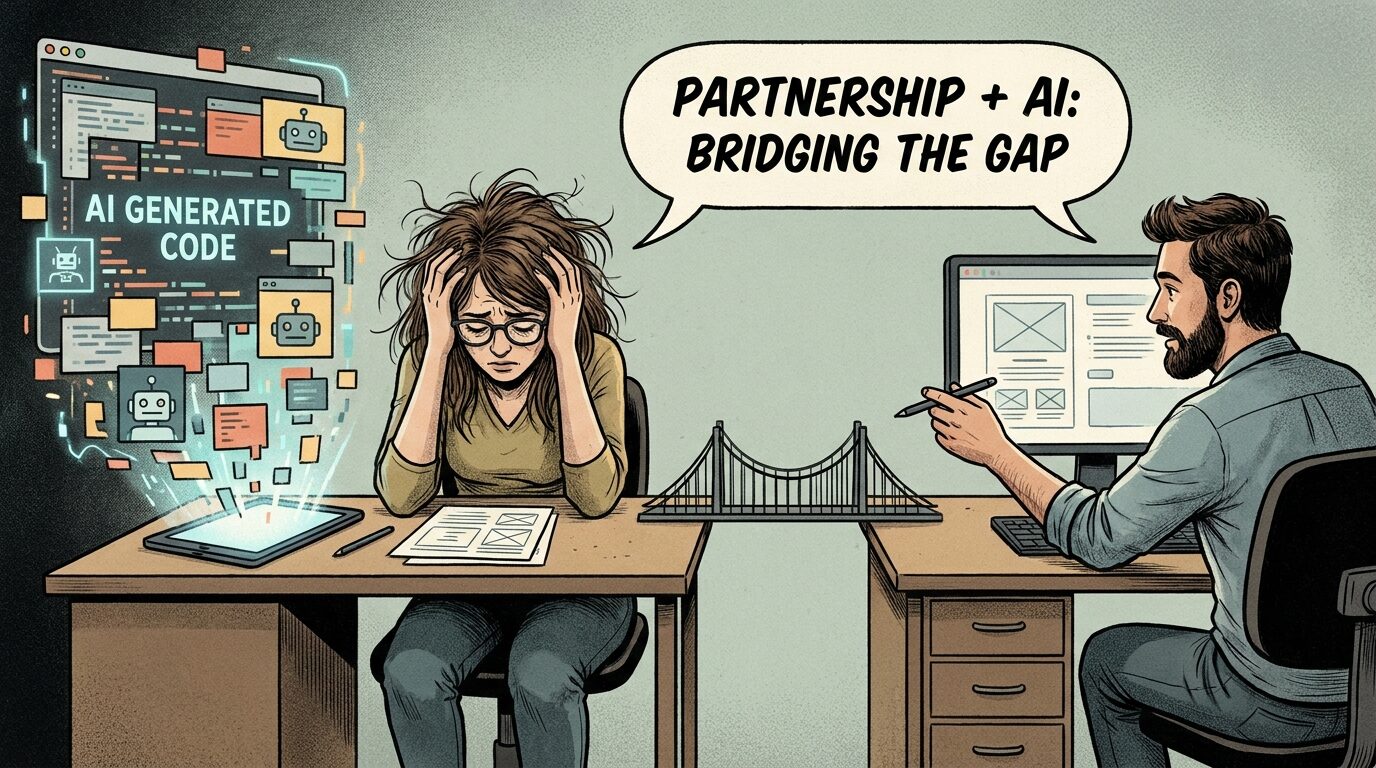
UX Designers and AI Prototyping: How to Embrace the Engineer Partnership
The relationship between UX designers and engineers has always been complex. Designers create visions. Engineers build realities. The gap between the two has historically been a source of frustration on both sides, with designers feeling their work is compromised in implementation and engineers feeling they are handed designs that ignore technical constraints.
AI prototyping tools are changing this dynamic in ways that are both exciting and challenging. For the first time, designers can produce high-fidelity interactive prototypes that closely resemble real implementations, and in some cases generate actual code from designs. This is narrowing the design-to-development gap, but it is also raising new questions about roles, skills, and collaboration.
What AI Prototyping Tools Actually Do
AI prototyping tools in 2026 range from design-to-code generators like Vercel v0 and Locofy, to AI-assisted design tools built into platforms like Figma, to fully autonomous interfaces that can build working UI components from natural language descriptions. These tools can dramatically accelerate the early stages of product design, enabling teams to go from concept to testable prototype in hours rather than days.
But speed comes with trade-offs. AI-generated prototypes often make assumptions about interaction patterns, component behavior, and visual hierarchy that may not align with the product vision or user research insights. They excel at producing plausible-looking interfaces quickly, but plausible is not the same as optimal.
Why Designers Are Struggling with the Transition
Many UX designers are finding the shift to AI-assisted workflows disorienting. Several factors contribute to this:
Loss of Control Over the Design Process
Traditional UX design involves deliberate, intentional decisions at every stage. When an AI generates a prototype from a brief description, many of those decisions are made automatically, often in ways the designer would not have chosen. Regaining control requires understanding not just how to prompt AI tools effectively, but how to critically evaluate and modify their output.
Blurring of Roles
When AI can generate code from designs, and designs from code, the line between designer and developer becomes less clear. Some designers feel threatened by this. Others see it as an opportunity to expand their skills and influence. The designers who are thriving in this environment tend to be those who embrace the expanded role rather than defending the boundaries of the old one.
Quality Control Challenges
AI-generated interfaces can look convincing while containing subtle usability problems, accessibility violations, or interaction patterns that do not match established conventions. Evaluating AI output requires strong foundational UX knowledge, because the tool will not flag its own mistakes.
Building a Better Designer-Engineer Partnership
The most productive response to AI prototyping tools is not for designers to compete with engineers or for engineers to sideline designers, but for both to collaborate more closely using AI as a shared medium.
Shared Prototyping Sessions
Some of the most effective teams are running joint prototyping sessions where designers and engineers work together in real time, using AI tools to generate initial implementations that both sides then refine collaboratively. This approach surfaces technical constraints early, keeps design intent intact, and produces implementations that are both visually strong and technically sound.
Designer-as-Reviewer
In teams where engineers are using AI tools to generate UI code, designers are increasingly taking on a reviewer role, evaluating generated interfaces against user research, design system standards, and usability principles. This is a natural evolution of the design review process and keeps designers central to quality even as the tools change.
Shared Understanding of Constraints
The best designer-engineer partnerships are built on mutual understanding. Designers who understand basic implementation constraints make better design decisions. Engineers who understand user experience principles make better implementation decisions. AI tools that make prototyping easier do not eliminate the need for this mutual understanding. If anything, they make it more important, because the speed of iteration is higher and the cost of misalignment is greater.
Skills Designers Need to Stay Relevant
The UX designers who will remain essential as AI tools mature are those who develop skills that AI cannot easily replicate:
- Deep user empathy: Understanding the emotional and cognitive experience of users requires human judgment that current AI tools cannot replicate.
- Strategic design thinking: Connecting design decisions to business outcomes and user needs at a strategic level remains a uniquely human skill.
- Critical evaluation of AI output: Knowing when AI-generated designs are good enough and when they need significant revision requires strong foundational knowledge.
- Communication and facilitation: Building alignment between stakeholders, conducting user research, and facilitating design critiques are deeply human activities.
- Prompt engineering for design tools: Getting useful output from AI design tools requires skill in framing problems, providing context, and iterating on prompts.
The Future of the Designer-Engineer Relationship
The most likely future is not one where AI replaces either designers or engineers, but one where the tools available to both change significantly, and where the boundary between the two roles becomes more fluid. Teams that adapt to this reality by building genuine cross-functional collaboration, using AI tools to accelerate shared work rather than to replace human judgment, will produce better products faster than those that hold onto traditional role boundaries.
At Web Creative Clicks, our design and development teams work in close partnership from the start of every project. If you want a product built by a team that knows how to combine design excellence with technical quality, get in touch.
🧠 Where AI Prototyping Still Falls Short
Despite rapid progress, AI prototyping tools are not yet capable of fully understanding contextual product intent. This creates several important limitations that UX teams must actively manage.
One major gap is emotional design awareness. AI can replicate layouts and interaction patterns, but it does not truly understand emotional nuance—how a user feels when navigating a product. This is critical in areas like onboarding flows, checkout experiences, or error handling, where frustration and trust play a key role.
Another limitation is inconsistent design systems usage. While many tools claim to follow design systems, they often misapply spacing, typography hierarchy, or component behavior. Without careful human review, this can lead to fragmented user experiences that feel “almost right” but subtly off.
Finally, AI tools struggle with edge cases and product complexity. Real-world applications often include exceptions, permissions, and conditional logic that are not easily captured in a simple prompt. Engineers still need to refine and rebuild significant portions of AI-generated output to ensure reliability.
⚙️ How Engineers Are Adapting to AI-Driven Design Workflows
Engineers are not passive observers in this shift—they are actively reshaping their workflows around AI-assisted design.
Many development teams now begin implementation earlier in the cycle using AI-generated prototypes as a living specification rather than a static design file. This allows engineers to:
🔹 Identify technical constraints earlier
🔹 Suggest alternative interaction patterns
🔹 Reduce back-and-forth during implementation
🔹 Validate feasibility before full-scale development
In some teams, engineers are even contributing directly to prompt design, helping UX teams structure inputs that generate more technically realistic outputs. This shared responsibility improves alignment and reduces friction later in the build process.
🔄 The Rise of “Designable Code” and “Buildable Design”
One of the most significant shifts introduced by AI prototyping is the convergence of design and development artifacts.
Traditionally:
- Designers worked in tools like Figma
- Engineers worked in frameworks like React or Vue
Now, AI-generated outputs often blur that separation, producing component-ready code from design inputs.
This has led to two emerging concepts:
🧩 Designable Code
Code structured in a way that remains easy to visually modify and iterate on without deep engineering overhead.
🖌️ Buildable Design
Designs created with implementation constraints in mind, ensuring they translate cleanly into production systems.
The teams that succeed in this new environment are those that treat design and code as two views of the same system, rather than separate phases of work.
📊 Why Alignment Matters More Than Speed
AI tools significantly increase the speed of iteration—but speed without alignment can be dangerous.
When teams move too quickly without shared understanding, they risk:
❌ Building features that look correct but behave incorrectly
❌ Creating inconsistent user journeys
❌ Accumulating technical debt through repeated redesigns
❌ Losing product coherence across iterations
This is why alignment between UX designers and engineers is becoming more important than ever. AI does not remove the need for communication—it amplifies its importance.
🧭 New Collaboration Models Emerging in Product Teams
Forward-thinking product teams are already experimenting with new collaboration structures:
🔹 Unified Product Pods
Designers, engineers, and product managers work together from the first idea to final implementation, using AI tools as a shared workspace.
🔹 Prototype-First Development
Instead of static wireframes, teams begin with interactive AI-generated prototypes that evolve into production code.
🔹 Continuous Design Engineering Loop
Design and development happen simultaneously in iterative cycles rather than sequential phases.
These models reduce friction and help teams respond faster to user feedback while maintaining quality.
🚀 The Real Opportunity: Shared Intelligence, Not Tool Replacement
The biggest misconception about AI prototyping is that it replaces designers or engineers. In reality, it expands what both roles can do—but only if they evolve together.
The real opportunity is not automation, but shared intelligence:
- Designers gain faster access to implementation reality
- Engineers gain earlier exposure to user intent
- AI becomes a translation layer, not a decision-maker
Teams that understand this shift are already building faster, more cohesive products with fewer misunderstandings and rework cycles.
🏁 Conclusion: A New Era of Collaborative Design
The UX designer–engineer relationship is not disappearing—it is transforming.
AI prototyping tools are removing traditional barriers, but they are also exposing a deeper truth: successful product design has always depended on collaboration, not separation.
In this new era, the most effective teams will not be those who rely most heavily on AI, but those who use it to strengthen human collaboration, clarity, and shared understanding.
At Web Creative Clicks, we believe the future of product development is not designer vs engineer—but designer with engineer, empowered by AI, aligned by intent, and driven by outcomes.
Practical Framework: How Teams Can Actually Work in This New Model
Understanding the shift is one thing. Implementing it inside real product teams is another. To make UX–engineering collaboration effective in an AI-driven workflow, teams need a structured operating model rather than informal experimentation.
A practical framework that many high-performing teams are converging toward looks like this:
1. Start With Shared Problem Framing (Not Design First)
Instead of beginning with wireframes or UI ideas, teams should first define:
- The user problem in plain language
- The business goal behind the feature
- The constraints (technical, time, data, platform)
- The success metrics
This ensures that AI tools are used to explore solutions, not to accidentally encode misunderstood requirements.
When this step is skipped, AI prototyping often amplifies the wrong direction faster, not the right one.
2. Use AI as a Divergence Tool, Not a Decision Maker
AI prototypes should be treated as exploration material, not final direction.
A healthy workflow is:
- Designers generate 3–5 AI variations of a concept
- Engineers quickly flag feasibility constraints
- The team merges insights into a refined direction
This prevents over-attachment to any single AI-generated output, which is a common failure pattern in early adoption teams.
3. Converge Through Human Review Loops
Once direction is chosen, AI output should be filtered through structured review layers:
- UX review (usability, clarity, flow)
- Engineering review (performance, scalability, architecture)
- Product review (business alignment, prioritization)
This creates a multi-perspective validation loop, ensuring AI accelerates quality rather than bypassing it.
4. Treat Components as Shared Language
Modern product teams are increasingly standardizing around component-based systems where:
- Designers think in components, not pages
- Engineers build reusable UI blocks
- AI generates within those constraints
This shift is critical. Without it, AI tools produce inconsistent UI variations that cannot scale into real products.
A shared component library becomes the “translation layer” between design intent and engineering reality.
📊 Measuring Success in AI-Augmented Design Teams
As workflows evolve, traditional productivity metrics (like “number of screens designed” or “lines of code written”) become less meaningful.
Instead, successful teams measure:
🔹 Time-to-validated-prototype
How quickly an idea moves from concept → testable experience with real feedback.
🔹 Design-to-dev alignment rate
How often engineering implementation matches design intent without rework.
🔹 Iteration efficiency
How many cycles are needed before a feature is considered production-ready.
🔹 User validation speed
How fast real user feedback is collected and integrated into the product.
These metrics reflect the true advantage of AI: not just speed, but compression of learning cycles.
⚠️ New Risks Emerging in AI-Driven UX Workflows
While the benefits are significant, new risks are also emerging that teams must actively manage.
1. “False Confidence Design”
AI-generated prototypes often look polished enough to feel “finished,” even when they are not validated. This can lead teams to overestimate product readiness.
2. Homogenization of UX
Because many AI tools are trained on similar design patterns, products risk becoming visually and functionally similar. This reduces differentiation and brand identity.
3. Loss of Deep UX Thinking
If teams rely too heavily on AI for ideation, there is a risk that foundational UX reasoning skills slowly weaken over time.
4. Engineering Debt from Rapid Prototyping
Fast AI-generated iterations can create hidden technical complexity when not properly refactored before production.
The key mitigation strategy across all risks is the same: intentional human oversight at every stage of AI use.
🔮 What the Next Phase (2027 and Beyond) Likely Looks Like
The current stage of AI prototyping is just the beginning. The next evolution will likely include:
🧠 Context-aware design systems
AI tools that understand product history, user behavior, and brand constraints deeply enough to generate more aligned UI by default.
🔄 Continuous UI generation
Interfaces that evolve dynamically based on real user data, with designers acting more like system architects than screen creators.
🤝 Real-time designer–engineer co-editing
Shared environments where UI, logic, and code are edited simultaneously in a single workspace.
🧩 Fully integrated product creation stacks
Where ideation, prototyping, testing, and deployment are connected into one continuous AI-assisted pipeline.
In this future, “handoffs” between design and engineering may almost disappear entirely.
🧭 Final Perspective: The Role of Humans Becomes More Important, Not Less
Despite the automation and acceleration, one reality remains constant:
AI does not understand why a product exists—it only helps build how it might work.
That distinction is what keeps UX designers and engineers essential.
- Designers bring meaning, empathy, and behavioral insight
- Engineers bring structure, reliability, and execution integrity
- AI accelerates everything in between
The strongest teams will not be those who rely most on AI, but those who use it to tighten the loop between thinking and building without losing judgment in the process.
🏁 Closing Thought
The UX designer and engineer relationship is no longer defined by handoffs and silos. It is becoming a continuous collaboration space where ideas are shaped, tested, and refined in real time.
AI is not replacing that relationship—it is forcing it to mature.
And in that maturity lies the real opportunity: building products where design intent and technical reality are no longer in tension, but in alignment from the very beginning.